
Call Us For Easy
Confidential Assistance
503-506-0101
It only takes 5 minutes to get started
Inpatient vs. Outpatient Rehab: Why Residential Treatment Offers the Best Chance for Long-Term Recovery
Posted on: January 1st, 2026 by writer

Table of Contents
- Not All Addiction Treatment Is Created Equal: IOP, PHP, and Residential Care Explained
- The Neuroscience Nobody Tells You: How Your Zip Code Affects Your Recovery
- The Family Dynamic No One Warns You About: Why Outpatient Treatment Can Damage Relationships
- The Most Important Statistic in Addiction Treatment: Are You Actually Going to Finish?
- Geography as Treatment: How Pacific Ridge’s Location Becomes Part of Your Recovery
- Final Thoughts
When you or someone you love is ready to seek treatment for addiction, you’re faced with a critical choice: outpatient programs that allow you to stay home, or residential (inpatient) treatment that requires leaving your daily environment behind. While outpatient care seems convenient and less disruptive, mounting evidence reveals that where you heal matters as much as how you heal.
For moderate to severe substance use disorder, residential treatment isn’t just more intensive—it’s fundamentally different. By physically removing you from the people, places, and triggers that fuel addiction, residential programs create a neurological reset that outpatient care simply cannot replicate.
This isn’t about running away from your problems. It’s about giving your brain the space it desperately needs to rewire itself. For families in Portland, Eugene, and across Oregon struggling with addiction, understanding this distinction could be life-saving.
In this post, you’ll discover:
- How your environment directly impacts your brain’s ability to recover
- Why outpatient programs often fail for those with serious addiction
- What makes residential treatment uniquely effective for lasting change
- How Pacific Ridge’s Jefferson, Oregon location leverages nature and isolation as therapeutic tools
Not All Addiction Treatment Is Created Equal: IOP, PHP, and Residential Care Explained
Before comparing effectiveness, it’s essential to understand what distinguishes outpatient from inpatient care—and who each approach is designed to serve.
Intensive Outpatient Programs (IOP) and Partial Hospitalization (PHP)
These outpatient models allow patients to attend therapy for 4-8 hours daily while returning home each night. On the surface, this arrangement appears ideal—you can maintain work responsibilities, stay connected with family, and practice sobriety in real-world conditions.
But here’s the critical vulnerability: you’re exposed to your “using environment” for 16+ hours every day.
IOP and PHP work best for highly motivated individuals who have stable, sober home environments and minimal relapse history. If you caught your substance use early, have strong family support, and your home is free from triggers, outpatient care can be appropriate. The key word is appropriate—not necessarily successful, but clinically matched to your risk level.
Residential (Inpatient) Treatment
Residential treatment provides 24/7 supervised care in a therapeutic community setting. Patients typically stay for 30-90 days, completely immersed in a recovery-focused environment. This approach is clinically recommended for individuals with moderate to severe addiction, co-occurring mental health disorders, or previous treatment failures.
The protective advantage is clear: physical separation from substances, triggers, and high-risk social circles.
When you’re at Pacific Ridge in Jefferson, Oregon, you can’t access your dealer. You can’t drive past the liquor store that became part of your daily routine. You can’t run into the friend who always had pills. These barriers aren’t punishments—they’re medical protections during your most vulnerable healing phase.
The ASAM Criteria: Clinical Guidelines for Treatment Matching
The American Society of Addiction Medicine provides standardized criteria for determining appropriate levels of care. These guidelines consider:
- Severity of addiction and withdrawal risk
- Medical complications
- Co-occurring mental health conditions
- Relapse potential
- Quality of your recovery environment
Most individuals seeking treatment for the first time with physiological dependence—meaning their body has adapted to the substance—meet criteria for residential care. The assessment isn’t about convenience or preference; it’s about clinical necessity.
The Common Misconception
Many people believe “outpatient is just as good but more convenient.” This belief can be dangerous.
The reality: Outpatient works when addiction is caught early and environmental supports are exceptionally strong. For established addiction patterns—especially when you’ve tried to quit before and couldn’t—attempting outpatient first often means losing precious time and momentum. Each failed attempt can deepen the neural pathways of addiction and erode your belief that recovery is possible.
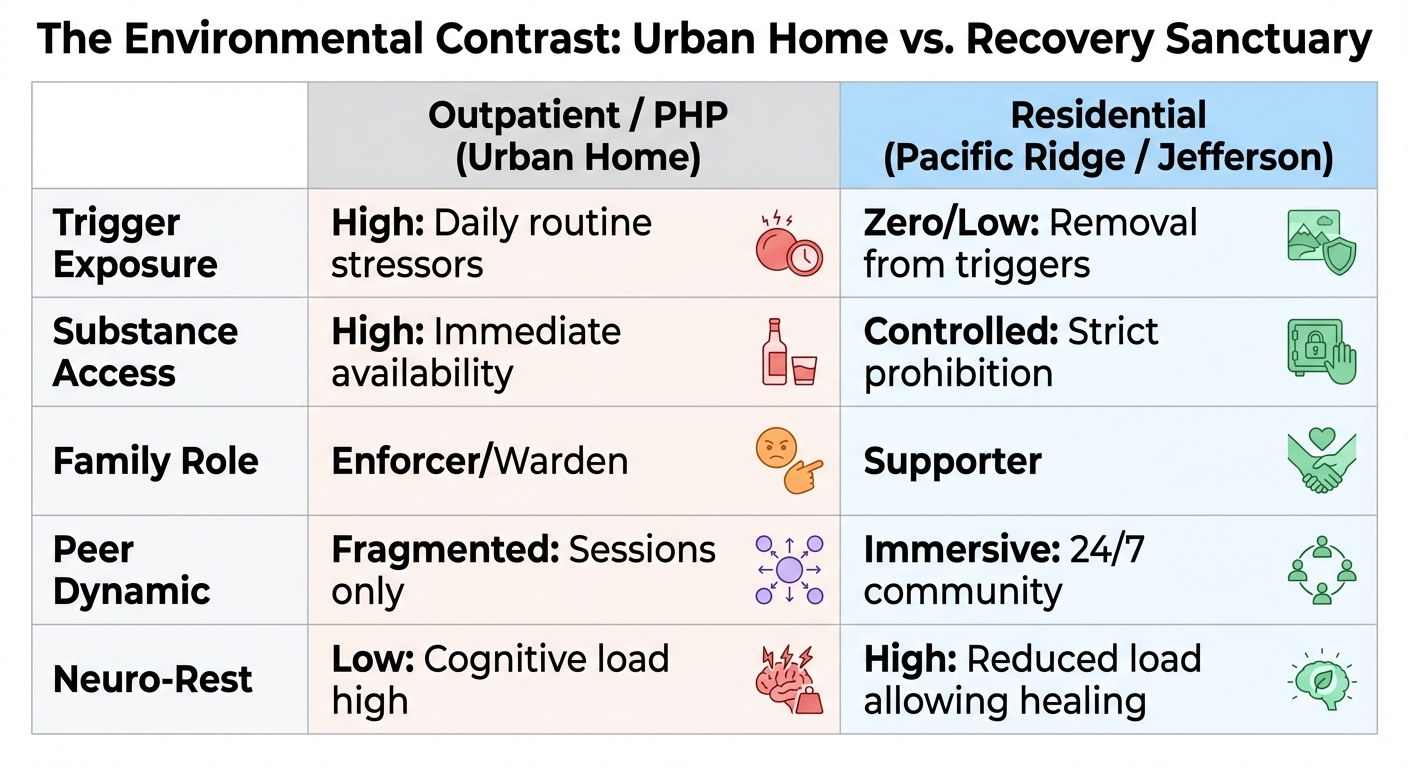
This comparison illustrates the fundamental differences between attempting recovery in your home environment versus a dedicated residential facility. Notice particularly the stark contrast in trigger exposure and substance access—factors that directly influence your brain’s ability to heal.
The Neuroscience Nobody Tells You: How Your Zip Code Affects Your Recovery
Understanding how addiction literally rewires your brain explains why “trying harder” at home often isn’t enough—and why changing your environment is a medical intervention, not an avoidance tactic.
Pavlovian Conditioning and Cue-Reactivity
Your brain has learned to associate specific places, people, and situations with substance use through a process called Pavlovian conditioning. It’s the same mechanism that made Pavlov’s dogs salivate at the sound of a bell.
Research shows that seeing a familiar liquor store, driving down a specific street, or even certain times of day can trigger dopamine spikes in your brain equivalent to actual drug use. These environmental cues activate your amygdala—the emotional, reactive part of your brain—while simultaneously suppressing your prefrontal cortex, which handles rational decision-making and impulse control.
For Portland and Eugene residents, this presents a unique challenge. Urban density means trigger exposure is constant and unavoidable. The bar where you spent Friday nights. The convenience store where you bought alcohol. The friend’s apartment where you used. These aren’t just memories—they’re active neural triggers that hijack your brain’s decision-making capacity.
The “Incubation of Craving” Phenomenon
Research from the National Institutes of Health reveals something counterintuitive and alarming: cravings don’t necessarily diminish with time away from substances. In fact, when you remain in drug-associated environments, cravings can actually intensify over time.
This is called the “incubation of craving.” Your brain doesn’t simply “forget” to crave substances. Instead, the neural pathways need active reprogramming away from triggering stimuli. Attempting sobriety while surrounded by these cues is neurologically analogous to trying to quit smoking while working in a tobacco shop—you’re asking your brain to fight against its learned associations every single moment.
Stimulus Control Through Strategic Relocation
When you move to a residential facility like Pacific Ridge in Jefferson, your brain is suddenly deprived of those familiar visual and spatial cues. There’s no “corner where I used to meet my dealer.” No “route I drove when drinking.” No physical spaces encoded with substance-use memories.
This geographic shift gives your prefrontal cortex—the rational, decision-making part of your brain—the metabolic energy it needs to heal. Instead of constantly defending against automatic urges triggered by your environment, your brain can focus on building new neural pathways associated with healthy coping mechanisms.
Jefferson’s rural setting offers zero proximity to dealers, using friends, or familiar haunts. This isn’t about permanent escape; it’s about creating a temporary sanctuary where your brain can rewire without constantly being ambushed by environmental triggers.
Nature’s Role in Neurological Healing
Studies published in the International Journal of Environmental Research and Public Health demonstrate that nature exposure significantly lowers cortisol—your body’s primary stress hormone—and reduces rumination, which is a key relapse trigger. This isn’t just about pretty scenery; it’s about measurable physiological changes that support recovery.
Pacific Ridge’s 18-acre setting leverages this natural healing effect intentionally. Patients describe feeling like they can “breathe” for the first time in years. The forest bathing effect (Shinrin-Yoku in Japanese tradition) provides documented benefits for stress reduction and mental clarity.
Contrast this with the typical outpatient patient experience: navigating city traffic, dealing with noise pollution, facing constant visual overstimulation, and managing urban stress. These patients maintain elevated cortisol levels throughout their treatment, which actively hinders the neurological stabilization process their brain desperately needs.
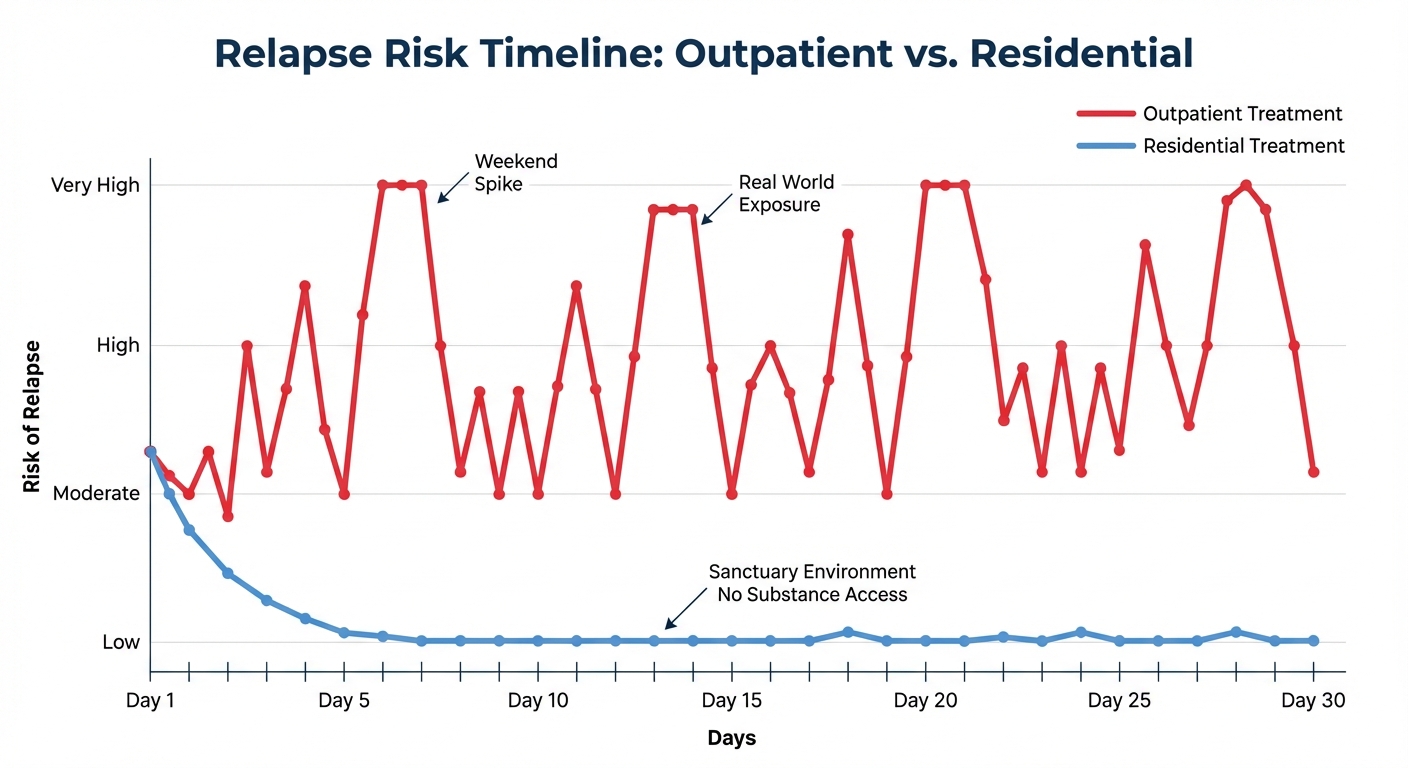
Your environment isn’t just a backdrop to your recovery—it’s an active participant in your brain’s healing process. And the science is clear: the calm, trigger-free environment of residential treatment provides your brain with advantages that no amount of willpower can replicate in a high-stress, trigger-dense urban setting.
The Family Dynamic No One Warns You About: Why Outpatient Treatment Can Damage Relationships
One of outpatient care’s most overlooked failures is how it forces families into roles that undermine both recovery and relationships. This dynamic creates a hidden burden that many families don’t anticipate until they’re living it.
The “Warden Effect”
When your loved one attends outpatient therapy during the day but returns home each night, someone has to monitor them. Parents find themselves checking their adult child’s breath for alcohol. Spouses search through pockets, scan text messages, and lie awake listening for the sound of a car starting at 2 AM.
This surveillance isn’t paranoia—it’s often necessary for safety. But it transforms families into substance police, creating a dynamic that breeds resentment, secrecy, and often spite-driven use.
The person in recovery feels infantilized and mistrusted, even when they’re genuinely trying. Family members feel exhausted, hypervigilant, and caught in an impossible position: monitor too closely and damage the relationship, or step back and risk a fatal overdose.
The Codependency Trap
Constant monitoring reinforces unhealthy family dynamics that were often present before addiction took hold. Family systems theory—the study of how family members interact and influence each other—shows that these surveillance roles actively interfere with the healthy reintegration needed after treatment.
The recovering individual never gets the opportunity to develop internal motivation because they’re always reacting to external control. Family members become so focused on policing behavior that they can’t provide genuine emotional support. Everyone is trapped in crisis mode, unable to move forward.
Research from the National Institute on Drug Abuse confirms that family involvement is most effective when families aren’t simultaneously serving as monitors. When loved ones can focus on emotional connection rather than behavioral surveillance, recovery outcomes improve significantly.
Residential Care Restores Healthy Roles
When your loved one enters residential treatment at Pacific Ridge, something remarkable happens for families: you immediately know they’re safe and supervised.
For many families, the first full night of sleep in months—or years—comes when their loved one enters residential care. The constant fear of overdose, the 3 AM check-ins to make sure they’re still breathing, the dread of every phone call—these anxieties are suddenly lifted.
This mental space allows families to step back from policing and return to being emotional supporters. Family therapy sessions can focus on healing relationships and planning for the future rather than managing immediate crises. Parents can be parents again, not prison guards. Spouses can be partners, not probation officers.
The Safety Assurance Factor
Residential treatment provides families with a guarantee that outpatient care cannot: your loved one physically cannot access substances.
This certainty is more valuable than many families realize until they experience it. Instead of spending emotional energy worrying about “what happened last night” or “will they make it to therapy today,” families can invest that energy in their own healing work. They can attend Al-Anon meetings. They can sleep. They can start processing their own trauma from living with active addiction.
Real Experiences from Pacific Ridge Families
Families consistently echo this theme: the geographic distance—while initially frightening—actually strengthened relationships. Weekly family sessions became productive and forward-focused rather than defensive and crisis-driven. Parents and spouses reported feeling like they got their loved one back, not just clean, but genuinely present and engaged.
The relief of knowing your loved one is safe, supervised, and working on recovery in an environment where failure is nearly impossible creates the foundation for authentic family healing—something that’s extraordinarily difficult to achieve when everyone is trapped in daily survival mode.
The Most Important Statistic in Addiction Treatment: Are You Actually Going to Finish?
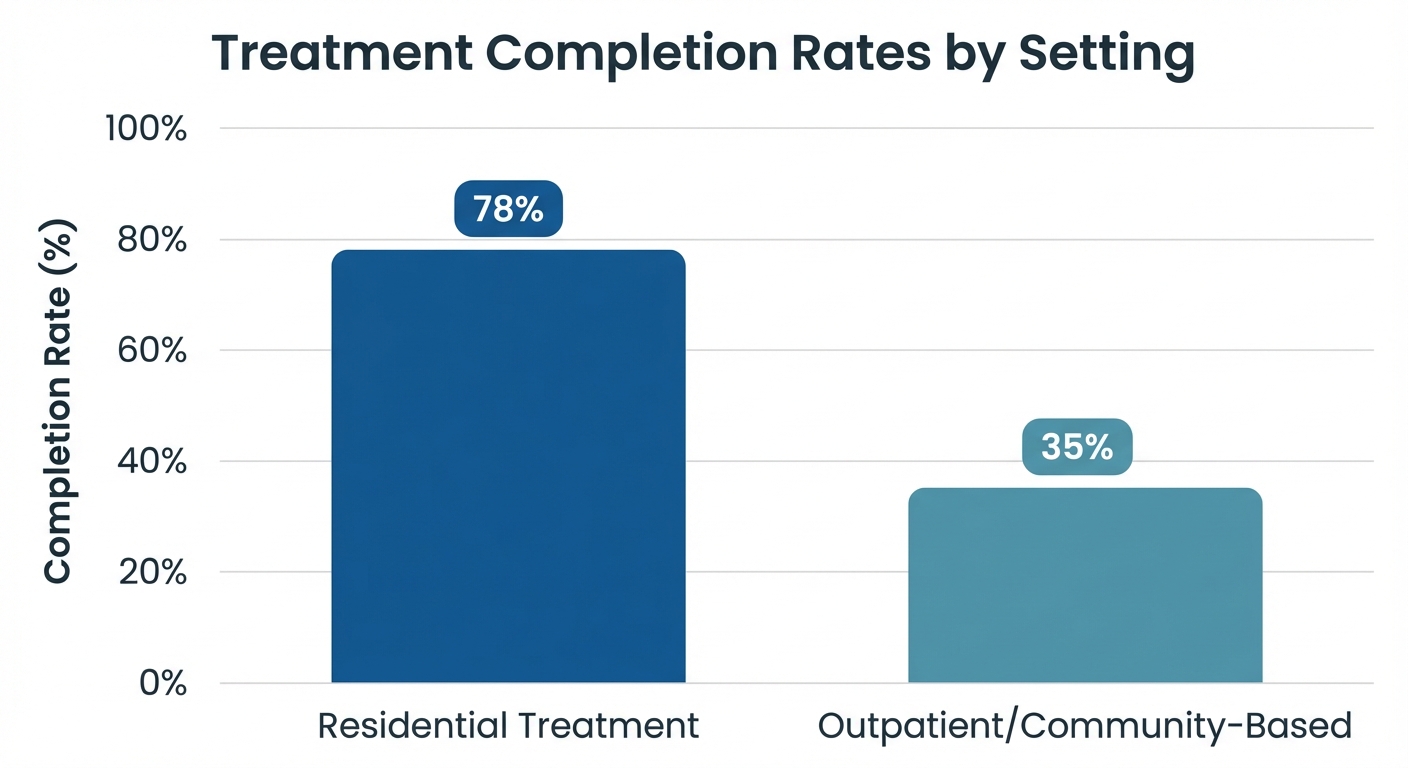
The best treatment program in the world doesn’t work if you leave early. This chart illustrates a critical reality: residential care’s structure dramatically improves completion rates—and completion rates determine your long-term success.
Treatment Completion as the #1 Predictor
Research consistently demonstrates that completing the recommended treatment duration is the strongest predictor of long-term sobriety. It’s not the specific therapy modality, the credentials of your therapist, or even the severity of your addiction—it’s whether you stay long enough for the treatment to work.
Every additional week in treatment correlates with improved outcomes. The brain needs time to heal, new coping mechanisms need practice to become automatic, and the neural pathways of addiction need to weaken through consistent non-reinforcement.
The problem: dropout rates are significantly higher in outpatient settings.
The “Speed Bump” Effect of Residential Care
In outpatient treatment, having a difficult day or experiencing an intense craving means you can simply not show up tomorrow. There’s no physical barrier between you and walking away. When therapy gets uncomfortable—and effective therapy often does—the path of least resistance is immediately available.
Residential care creates what clinicians call “speed bumps” to impulsive departure. The physical presence of staff, the structured daily schedule, and the peer community all create barriers to leaving against medical advice (AMA).
Research published in Drug and Alcohol Dependence Journal shows that patients in residential settings are significantly more likely to complete detoxification and stabilization phases compared to those in community-based outpatient programs. The controlled environment directly addresses the top reasons for dropout: easy access to substances, environmental stress, and social pressure to return to old patterns.
The “Against Medical Advice” Problem
Many people leave outpatient programs during therapeutic breakthroughs—the precise moments when real change is happening but discomfort is highest. When facing uncomfortable emotions or traumatic memories, having immediate access to substances makes psychological escape too easy.
You can walk out of an IOP session on Tuesday afternoon, stop at the liquor store by 5 PM, and never return. The clinical team has no mechanism to intervene.
In residential treatment, that impulsive departure is significantly harder. When you’re having a crisis at midnight, there are staff available to provide support through that critical window. When therapy brings up painful material, you can’t immediately numb it—you have to develop healthier coping strategies because substances simply aren’t available.
The Therapeutic Community Advantage
Residential care creates something that outpatient treatment cannot: a 24/7 therapeutic community. Meta-analyses of therapeutic communities show that “social learning” during downtime—meals, recreation, informal conversations—is as valuable as formal therapy sessions.
Recovery becomes socially contagious in residential settings. You watch peers handle difficult emotions without substances. You learn coping strategies through observation and conversation that happens organically throughout the day. You normalize recovery as the default instead of the exception.
The 24-Hour Therapeutic Cycle
In outpatient care, you get a therapeutic environment during your 4-8 hour session, then return to potentially chaotic home circumstances. In residential care, therapeutic moments happen continuously—a conversation over breakfast about handling stress, a walk with a peer after group therapy where they share what helped them, a late-night discussion about fears for the future.
Immersion vs. Fragmentation
Behavioral psychology confirms what common sense suggests: habit formation requires consistent environmental reinforcement. You can’t build new neural pathways when you’re constantly switching between therapeutic and triggering environments.
Outpatient patients get 4-8 hours in a recovery-focused setting, followed by 16+ hours of potential chaos—old friends calling, familiar triggers everywhere, the stress of hiding their attendance from coworkers. This fragmentation makes it exponentially harder for new behaviors to solidify into habits.
Residential patients live in recovery continuously. The environment consistently reinforces sobriety as normal and expected. New coping mechanisms get practiced repeatedly throughout each day, not just during therapy hours. This immersion allows behavioral changes to consolidate much more rapidly.
The Retention Data Is Clear
When we look at clinical outcomes, the advantage of residential care becomes undeniable. Patients who complete residential treatment have significantly higher long-term sobriety rates than those who complete outpatient treatment—but more importantly, they’re simply more likely to complete treatment in the first place.
If you don’t finish treatment, the quality of that treatment is irrelevant. Residential care’s structure, peer support, and physical barriers to impulsive departure dramatically improve your odds of staying long enough for recovery to take root.
Geography as Treatment: How Pacific Ridge’s Location Becomes Part of Your Recovery
For Oregon residents, the physical distance between urban temptation and rural healing isn’t just logistics—it’s a therapeutic intervention backed by evidence.
Oregon’s Addiction Landscape
Oregon consistently ranks high in national substance use metrics, presenting unique challenges for local recovery. Cities like Portland, Eugene, and Vancouver offer high accessibility to substances—dealers are a text away, liquor stores are on every corner, and the social networks that enabled use are deeply embedded in your daily geography.
For someone attempting outpatient care in these cities, the supply chain is simply too convenient. You might genuinely intend to stay sober, but when your brain is screaming for relief and you know exactly where to get it within 15 minutes, the battle becomes nearly impossible.
Strategic Relocation vs. “Geographic Cure”
There’s an old saying in recovery circles about the “geographic cure”—the false belief that you can run away from addiction by simply moving somewhere new. That approach doesn’t work because you take your brain, your trauma, and your coping deficits with you.
But temporary strategic relocation for treatment is entirely different and evidence-based. You’re not running away permanently; you’re creating a protected healing space where your brain can rewire without constant assault from environmental triggers.
Jefferson, Oregon offers the ideal balance: far enough from urban density to eliminate immediate access to substances and triggering locations, yet close enough for family visits and eventual reintegration planning.
The I-5 Corridor Buffer
Pacific Ridge sits away from the chaos of Oregon’s major metropolitan areas along the I-5 corridor. This physical separation creates a psychological break from what many patients describe as their “using identity.”
“In the city, I was ‘the guy who parties.’ Everyone knew that version of me. In Jefferson, nobody had any idea who I was before. I could be whoever I wanted to become.”
This identity shift is profound. When everyone around you has only known you as someone working on recovery, it becomes easier to believe that’s who you actually are.
Nature as Medicine
Pacific Ridge’s 18 acres of open space isn’t just aesthetic—it’s therapeutic infrastructure. The Japanese practice of Shinrin-Yoku (forest bathing) has documented physiological benefits: lowered blood pressure, reduced cortisol, improved immune function, and decreased symptoms of depression and anxiety.
Patients at Pacific Ridge aren’t just talked through recovery in sterile conference rooms. They process difficult emotions while walking through quiet forests. They practice mindfulness with bird songs and wind through trees as natural soundscapes. They learn that peace is possible without chemicals because they’re experiencing it directly.
Contrast this with the typical experience of urban outpatient patients: fighting traffic to get to therapy, navigating parking stress, sitting in clinical office buildings under fluorescent lights, then returning to traffic, noise, and visual chaos. The therapeutic benefit of even excellent therapy gets undermined by the constant elevation of stress hormones.
Accessibility for Families
Jefferson’s location provides what clinicians call “healthy boundaries.” It’s accessible for weekend family sessions—close enough that participation isn’t burdensome—but distant enough that families aren’t tempted to “just drop by” in ways that can undermine treatment structure.
When families do visit, they’re coming to a peaceful setting rather than an institutional clinical environment. Family therapy happens on walking trails or in comfortable common areas with windows overlooking nature. This context itself reduces defensiveness and opens communication in ways that sterile clinical settings often cannot.
Real Patient Perspective
Consider the experience of a 24-year-old from Eugene whose case study illustrates this geographic advantage. During two previous attempts at outpatient care in Eugene, they maintained contact with their social circle—people who were still using. Despite genuine intentions, the combination of easy dealer access and social pressure led to relapse within weeks both times.
At Pacific Ridge, the impossibility of contacting dealers during the first 30 days—not due to willpower but simple geographic reality—provided the protection their brain needed during the most vulnerable period. They later reflected: “I couldn’t have gotten those 30 days clean in Eugene. I wasn’t strong enough yet. I needed the distance to give my brain time to clear.”
Six months post-treatment, this patient remained sober and credited that initial geographic protection as life-saving. Once their brain had time to heal and new coping mechanisms had time to solidify, they were eventually able to return to Eugene without immediate relapse.
The Clinical Reality
The “where” of treatment matters. Your brain needs a sanctuary to heal—not permanently, but temporarily during its most vulnerable phase. For Pacific Northwest families, Pacific Ridge’s Jefferson location isn’t an inconvenient distance to travel. It’s a strategic clinical asset that leverages geography itself as a therapeutic tool.
Final Thoughts
Choosing between outpatient and residential addiction treatment isn’t just about schedule convenience or cost—it’s about giving yourself or your loved one the best possible chance at lasting recovery. The research is unambiguous: for moderate to severe substance use disorder, residential treatment offers distinct, clinically superior advantages.
The Core Truth
Addiction is a brain disease that exploits environment and habit. Outpatient treatment asks you to fight this disease while swimming in the same waters where you nearly drowned. You attend therapy, learn coping strategies, and then return to the triggers, people, and places that fuel your addiction for 16+ hours every day.
Residential care pulls you onto dry land. It gives your brain the neurological rest it desperately needs to heal, protected from the environmental cues that hijack your decision-making capacity. It teaches you to swim in safer waters before sending you back into rough seas.
What You’re Really Choosing
When you choose residential treatment at Pacific Ridge, you’re not just buying therapy sessions. You’re purchasing:
30+ days of neurological protection while your brain rewires away from triggers. Your amygdala can calm down. Your prefrontal cortex can heal. New neural pathways associated with healthy coping can form without constant interference from environmental cues.
Relief for your family from the impossible burden of 24/7 monitoring. Parents can sleep through the night. Spouses can stop being prison guards and return to being partners. Family therapy can focus on healing relationships rather than managing crises.
Immersion in a therapeutic community where recovery becomes the norm, not the exception. You’re surrounded by peers working toward the same goals, staff who understand the journey, and an environment designed entirely around healing. Recovery becomes contagious.
Geographic sanctuary where the impossibility of accessing substances gives you time to build genuine coping skills. This isn’t about willpower—it’s about creating physical barriers during your most vulnerable healing phase that your brain simply cannot bypass.
For Pacific Northwest Families
If you’re in Portland, Eugene, Vancouver, or anywhere in Oregon, the move from urban chaos to Jefferson’s quiet isn’t running away—it’s a strategic, evidence-based intervention. It’s choosing to give yourself and your family the gift of time, safety, and real change.
The urban environment where addiction took hold isn’t a neutral backdrop—it’s an active participant in maintaining addictive behaviors. Every familiar street corner, every old friend who still uses, every bar you passed daily becomes a neurological trigger. Breaking that cycle requires breaking physical proximity to those triggers, at least temporarily.
Pacific Ridge offers that break. The 18 acres of natural setting, the distance from dealers and using networks, the peer community focused on recovery—these aren’t luxuries. They’re medical necessities for the kind of deep neurological healing that makes lasting sobriety possible.
Your Next Step
Recovery is possible. But it requires the right environment, especially at the beginning when your brain is most vulnerable and your coping skills are still developing.
If you’re ready to stop fighting addiction on its home turf, Pacific Ridge is ready to help you relocate to healing. Our Jefferson, Oregon location provides the geographic protection, therapeutic community, and evidence-based treatment that residential care uniquely offers.
Ready to Begin Your Recovery Journey?
The path to recovery starts with creating the right conditions for your brain to heal—and sometimes, that means changing where healing happens.
References:
- Substance Abuse and Mental Health Services Administration (SAMHSA). (2020). Treatment Improvement Protocol (TIP) 47: Substance Abuse: Clinical Issues in Intensive Outpatient Treatment. https://store.samhsa.gov/product/TIP-47-Substance-Abuse-Clinical-Issues-in-Intensive-Outpatient-Treatment/SMA13-4182
- National Center for Biotechnology Information (NCBI). (2018). Incubation of Craving: A Systematic Review. https://www.ncbi.nlm.nih.gov/pmc/articles/PMC5956708/
- International Journal of Environmental Research and Public Health. (2019). The Physiological Effects of Shinrin-Yoku (Taking in the Forest Atmosphere or Forest Bathing). https://www.ncbi.nlm.nih.gov/pmc/articles/PMC6589172/
- National Institute on Drug Abuse (NIDA). (2020). Family Therapy Can Help Patients and Families Navigate Addiction. https://nida.nih.gov/publications/principles-drug-addiction-treatment-research-based-guide-third-edition/evidence-based-approaches-to-drug-addiction-treatment/behavioral-therapies/family-behavior-therapy
- Drug and Alcohol Dependence Journal. (2021). Predictors of Retention in Substance Abuse Treatment. https://www.sciencedirect.com/journal/drug-and-alcohol-dependence
- National Institutes of Health (NIH). (2019). The Therapeutic Community: Theory, Model, and Method. https://www.ncbi.nlm.nih.gov/books/NBK64353/
- Oregon Health Authority. (2023). Alcohol and Other Drug Use in Oregon. https://www.oregon.gov/oha/ph/preventionwellness/substanceuse/pages/index.aspx
- Journal of Substance Abuse Treatment. (2020). Outcomes of Residential vs. Outpatient Care for Opioid Use Disorder. https://www.journals.elsevier.com/journal-of-substance-abuse-treatment
Posted in Treatment
Are you looking for help?
Pacific Ridge is a residential drug and alcohol treatment facility about an hour from Portland, Oregon, on the outskirts of Salem. We’re here to help individuals and families begin the road to recovery from addiction. Our clients receive quality care without paying the high price of a hospital. Most of our clients come from Oregon and Washington, with many coming from other states as well.
Pacific Ridge is a private alcohol and drug rehab. To be a part of our treatment program, the client must voluntarily agree to cooperate with treatment. Most intakes can be scheduled within 24-48 hours.
Pacific Ridge is a State-licensed detox and residential treatment program for both alcohol and drugs. We provide individualized treatment options, work closely with managed care organizations, and maintain contracts with most insurance companies.
Quick links
Recent Posts
Contact Us
Pacific Ridge- 1587 Pacific Ridge Ln SE
Jefferson, OR 97352 - Email:
[email protected] - Phone:
503-506-0101 - Fax:
503-581-8292

- Copyright © 2026 Pacific Ridge - All Rights Reserved. Web Design & SEO by Lithium
- Follow us on