
Call Us For Easy
Confidential Assistance
503-506-0101
It only takes 5 minutes to get started
How to Set Healthy Boundaries: Supporting a Loved One Without Enabling
Posted on: May 21st, 2026 by writer

Table of Contents
- The Critical Distinction: Are You Helping or Hurting?
- The 4 Most Common Enabling Behaviors (And Their Healthier Alternatives)
- CRAFT: The Evidence-Based Alternative to “Tough Love”
- The “If/Then” Framework: How to Set Boundaries That Actually Work
- Hope in Action: How Two Families Stopped Enabling and Started Healing
- You Can’t Pour From an Empty Cup: Self-Care for Families in Crisis
- Final Thoughts
You love them. You’d do anything to help them. But somehow, everything you do seems to make things worse.
If you’re reading this, you’re likely trapped in one of the most painful paradoxes a family can face: the harder you try to protect your loved one from their addiction, the more you might be prolonging their suffering. You’re not alone in this struggle. Nearly 48.7 million Americans battled substance use disorder in 2022, which means millions of families are desperately searching for answers on how to help without hurting.
For families in Oregon and throughout the Pacific Northwest, this crisis hits particularly close to home. Oregon ranks among the highest states for substance use disorders while simultaneously ranking near the bottom for treatment access. This gap leaves families feeling isolated, confused, and overwhelmed.
The central challenge is this: our natural instinct to protect the people we love can transform into “enabling”—a pattern of behavior that unintentionally shields our loved ones from the consequences they need to experience in order to change. This guide will teach you the evidence-based difference between supporting recovery and enabling addiction, using proven frameworks like Community Reinforcement and Family Training (CRAFT).
At Pacific Ridge, we serve families throughout the Pacific Northwest with compassionate, research-driven residential treatment. We understand that recovery isn’t just about treating the individual—it’s about healing the entire family system.
The Critical Distinction: Are You Helping or Hurting?
The line between support and enabling isn’t always obvious, especially when you’re emotionally exhausted and terrified of losing someone you love. Understanding this distinction requires looking at the psychological foundations of both behaviors.
Enabling is driven by short-term anxiety relief and conflict avoidance. When you pay your adult son’s rent so he doesn’t get evicted, you’re primarily soothing your own fear of what might happen to him. When you call his employer with an excuse for why he missed work, you’re avoiding the uncomfortable confrontation that would occur if you let him face the consequences.
Supporting, on the other hand, is driven by long-term recovery goals. It prioritizes what will ultimately help your loved one get well, even when those actions feel counterintuitive or painful in the moment.
Addiction is frequently called a “family disease” because approximately 1 in 5 adults grew up with an addicted relative, creating generational patterns of codependency and enabling. These patterns feel normal because they’ve been modeled for us our entire lives. Breaking them requires conscious, deliberate effort.
Let’s debunk some common myths that keep families trapped in enabling patterns:
Myth: “If I don’t help them, they might die.”
Reality: While this fear is understandable, research shows that experiencing consequences is often the primary catalyst for individuals seeking treatment. Shielding someone from consequences can actually delay their decision to get help.
Myth: “I’m just being a good parent/spouse.”
Reality: There’s a critical difference between unconditional love and unconditional rescue. You can love someone deeply while still refusing to participate in their self-destruction.
To help you recognize these patterns in your own life, here’s a practical comparison:
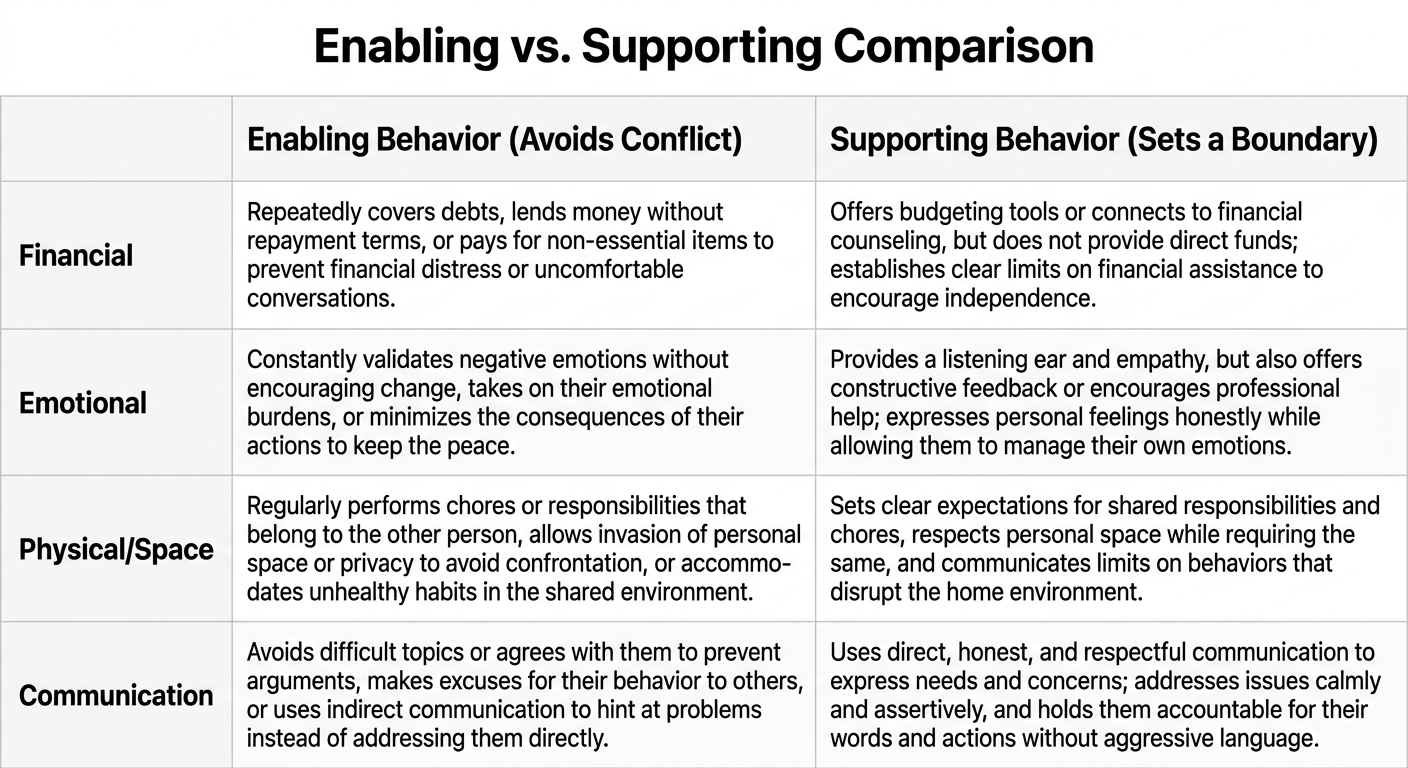
This table illustrates the key differences across four critical areas: financial decisions, emotional responses, physical boundaries, and communication patterns. Notice how enabling behaviors focus on preventing immediate discomfort, while supporting behaviors prioritize long-term healing—even when that healing requires short-term pain.
The 4 Most Common Enabling Behaviors (And Their Healthier Alternatives)
Now that we understand the theoretical difference between enabling and supporting, let’s examine the specific behaviors that trap families in destructive cycles. By recognizing these patterns, you can begin to implement healthier alternatives immediately.
1. Financial Enabling
The Pattern: You pay your loved one’s rent, car payments, phone bill, or hand them cash to prevent homelessness, repossession, or other financial crises. Your reasoning seems logical: “If they lose their car, they’ll lose their job, and then they’ll really spiral.”
Why It Backfires: Financial enabling removes the natural consequence—financial crisis—that often motivates people to seek treatment. When someone knows you’ll always catch them before they fall, there’s no urgency to change. Every dollar you give them is a dollar they don’t have to earn while sober.
The Boundary Alternative: “I will not give you money or pay your bills. However, I will gladly pay directly for treatment, therapy, medical detox, or other recovery services at a facility like Pacific Ridge. I will also purchase groceries or essential items directly, but I will not hand you cash.”
This boundary removes the safety net that enables continued use while clearly demonstrating your willingness to invest in their recovery.
2. Emotional Enabling
The Pattern: You lie to your loved one’s employer about why they missed work. You make excuses to extended family members about why they couldn’t attend an event. You cover up their intoxication at social gatherings or legal proceedings.
Why It Backfires: Each time you lie on their behalf, you prevent them from experiencing the social and professional accountability that could motivate change. You’re also teaching them that their actions don’t have real consequences—that someone will always clean up their mess.
The Boundary Alternative: “I love you, but I will not lie on your behalf. You will need to handle this situation yourself. If you need help figuring out what to say to your employer about treatment, I’m happy to help you draft an honest explanation.”
This approach maintains your integrity while placing the responsibility where it belongs—on the person whose choices created the situation.
3. Physical/Space Enabling
The Pattern: You allow substances in your home because you want to “keep an eye on them” or prevent them from using in more dangerous locations. You let them stay in your home despite active substance use because you’re terrified they’ll end up on the streets.
Why It Backfires: Allowing substances in your home normalizes their use and creates an unsafe environment for everyone, including other family members. It also sends the message that their addiction is acceptable as long as it happens under your roof.
The Boundary Alternative: Establish a strict “no substances in this house” rule with clear, enforced consequences. “I love you and you’re welcome in this home, but not if you’re actively using. If you bring substances into this house or arrive intoxicated, I will ask you to leave. I will happily help you find a treatment program or sober living facility.”
4. Communication Enabling
The Pattern: You argue, plead, or negotiate with your loved one while they’re actively intoxicated. You engage in circular conversations about their drinking or drug use during or immediately after they’ve used.
Why It Backfires: Attempting serious conversations while someone is under the influence is pointless—their brain chemistry is altered and they’re incapable of rational discussion. Additionally, your attention during these moments can actually reinforce the behavior. From a behavioral psychology perspective, attention—even negative attention—is a reward.
The Boundary Alternative: Calmly disengage when they’re intoxicated. “I can see you’ve been drinking, and I’m not willing to have this conversation right now. I love you, and we can talk about this when you’re sober.” Then physically remove yourself from the situation.
Research from the National Institute on Drug Abuse confirms that experiencing negative consequences is a primary catalyst for individuals seeking treatment. By removing these four types of enabling, you’re not abandoning your loved one—you’re creating the conditions where reality can become their teacher.
CRAFT: The Evidence-Based Alternative to “Tough Love”
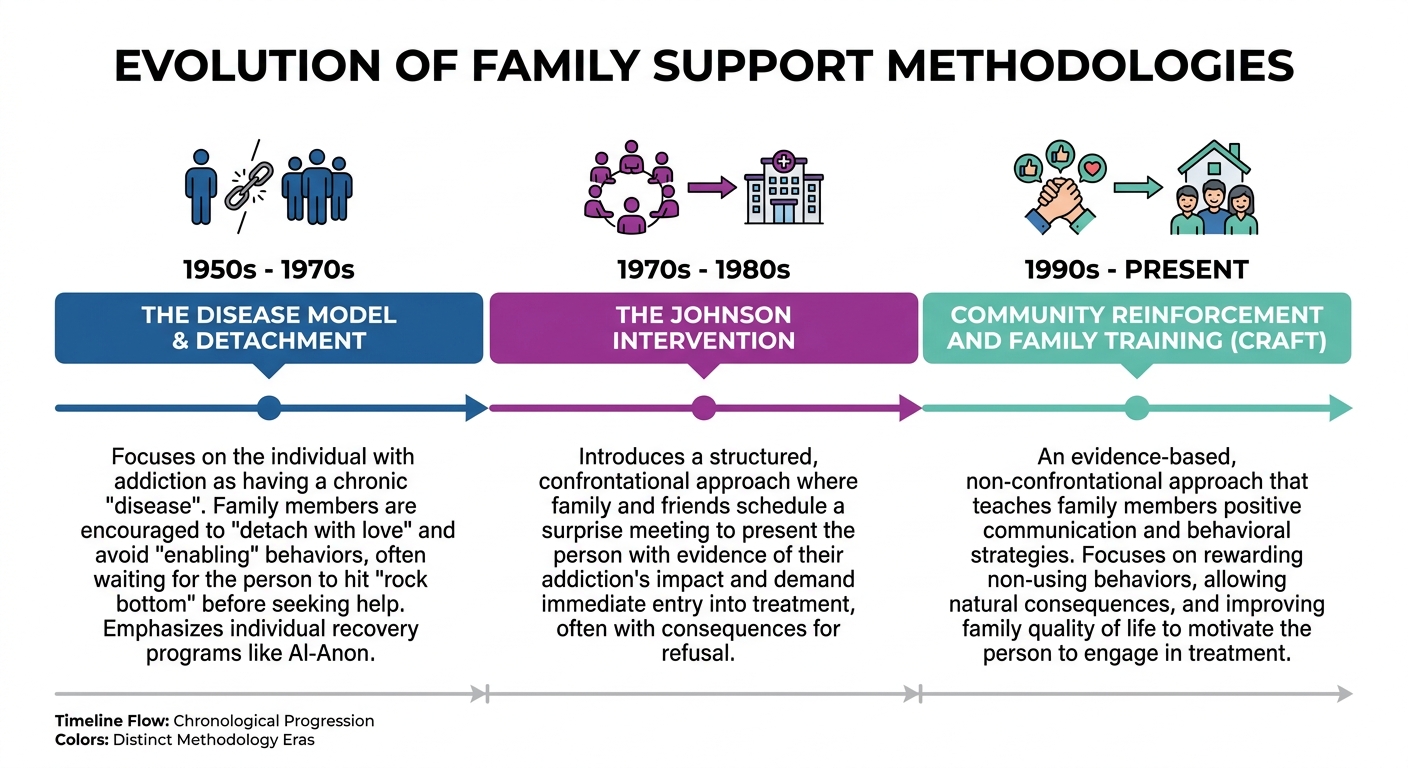
For decades, families felt they had only two options: detach completely or stage a confrontational intervention. Fortunately, modern behavioral science has given us a third, far more effective approach.
The history of family involvement in addiction treatment reveals a significant evolution. In the 1950s through 1970s, programs like Al-Anon popularized “loving detachment,” encouraging families to accept their powerlessness and focus on their own healing. While this approach helped many family members cope, it didn’t actively engage the addicted individual in treatment.
The 1970s and 1980s brought the “Johnson Intervention”—the confrontational ambush model popularized by television shows. Research has since shown this method has high dropout rates and can severely damage family relationships. The aggressive confrontation often triggers defensive reactions rather than genuine motivation to change.
Then came Community Reinforcement and Family Training (CRAFT), developed by Dr. Robert Meyers in the 1990s. This evidence-based methodology teaches families to use positive reinforcement and strategic behavioral modification instead of confrontation or detachment. The results speak for themselves: CRAFT successfully engages nearly 70% of treatment-resistant individuals into care—dramatically higher than traditional intervention models.
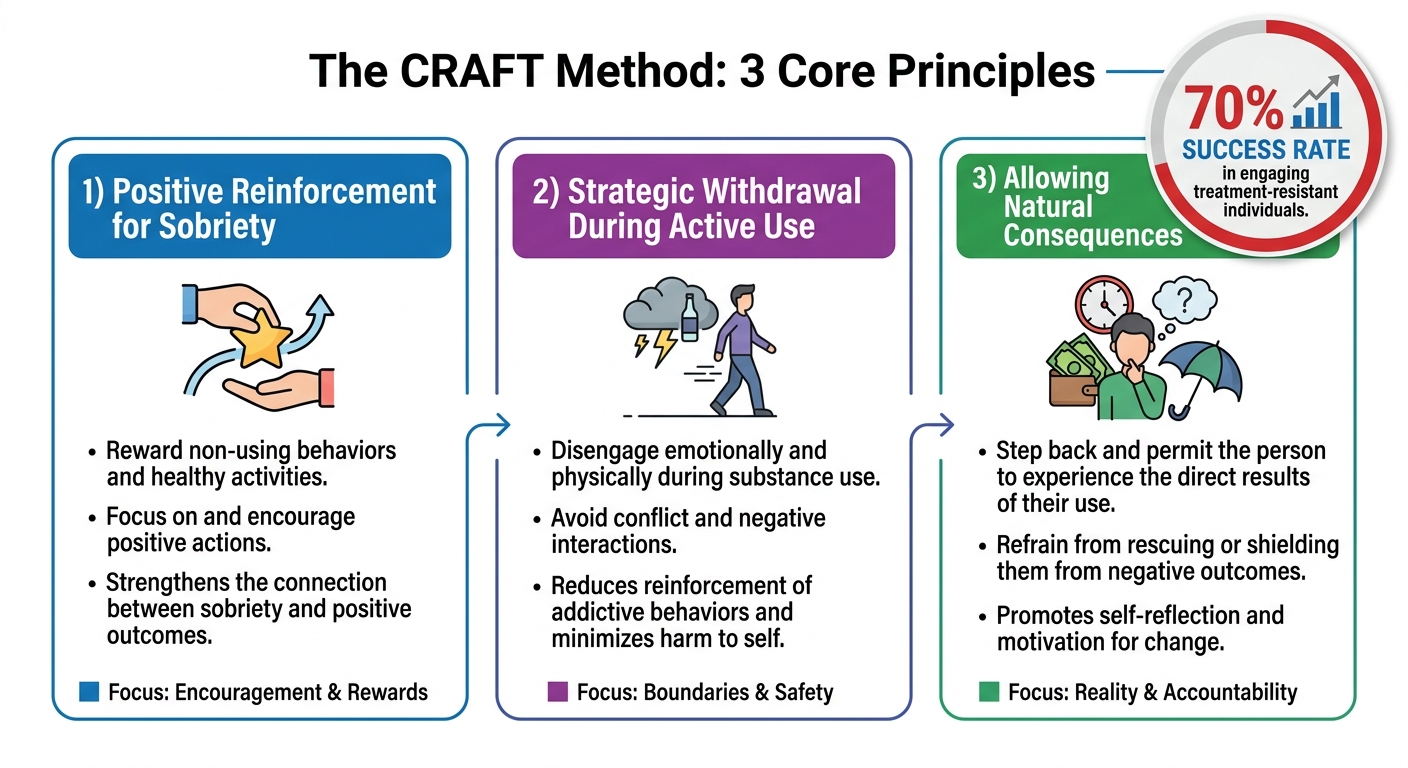
The Three Core CRAFT Principles
1. Positive Reinforcement for Sobriety
Instead of focusing all your energy on what your loved one is doing wrong, CRAFT teaches you to actively reward non-using behavior with attention, praise, and engagement. This isn’t about being fake or manipulative—it’s about consciously noticing and reinforcing the behaviors you want to see more of.
Example: “I really love spending time with you when you’re sober. You’re funny and engaged, and I feel like I’m talking to the person I fell in love with. Let’s cook dinner together tonight and watch that show you’ve been wanting to see.”
2. Strategic Withdrawal During Active Use
This principle directly counters communication enabling. When your loved one is actively using, you remove the “reward” of your presence and attention. You’re not punishing them or being cruel—you’re simply refusing to participate in or witness their self-destruction.
Example: When you notice they’ve been drinking, calmly state: “I love you, but I’m not going to be around you when you drink. I’m going to my room to read.” Then follow through by physically leaving the space.
This isn’t about giving them the silent treatment or withdrawing your love. It’s about creating a clear association: sobriety gets my engaged, positive presence; intoxication gets my absence.
3. Allowing Natural Consequences
This is perhaps the hardest principle for loving family members to implement, but it’s also the most powerful. You stop rescuing your loved one from the results of their choices. You let reality be their teacher.
This doesn’t mean you abandon them in genuinely dangerous situations requiring medical intervention. It means you stop preventing them from experiencing the emotional, financial, legal, and social consequences of their addiction.
CRAFT in Action: A Real-World Example
Consider a spouse who was caught in a nightly cycle of arguing with her intoxicated husband. Every evening, the same pattern: he’d start drinking, she’d confront him, he’d become defensive, voices would escalate, and both would end the night emotionally devastated. She felt trapped—if she didn’t engage, wasn’t she abandoning him?
Working with a family therapist, she implemented CRAFT principles. When her husband began drinking each evening, she would calmly state, “I love you, but I’m not going to be around you when you drink,” and would leave to read in another room or take a walk. She stopped arguing, stopped pleading, stopped engaging.
Critically, she also changed her behavior during his sober periods. On mornings after he didn’t drink, she was warm, engaged, and affectionate. She cooked his favorite breakfast, initiated positive conversations, and suggested activities they could do together.
Within weeks, the drinking episodes began to decrease. Her husband started to notice the pattern: when he drank, he lost her company; when he was sober, he gained positive attention and connection. After several months of this consistent approach, he became receptive to discussing an intake assessment for treatment.
This isn’t a miracle story—it’s behavioral science in action. By removing the reward (attention) during substance use and amplifying it during sobriety, families can create powerful motivation for change.
The “If/Then” Framework: How to Set Boundaries That Actually Work
Understanding CRAFT principles is valuable, but you also need specific, practical communication tools you can use in high-stress moments. The “If/Then” framework provides a clear structure for setting boundaries that actually get enforced.
1. The “If/Then” Model
Boundaries without consequences aren’t boundaries—they’re suggestions. For a boundary to be effective, it must include both a clear condition and a clear consequence that you’re willing and able to enforce.
The Template: “If you [specific behavior], then I will [specific consequence].”
Examples:
- “If you choose to drink in this house, then I will ask you to leave.”
- “If you arrive at Sunday dinner intoxicated, then I will ask you to go home and you’ll be welcome to join us next week when you’re sober.”
- “If you continue to ask me for money, then I will end this conversation.”
The Critical Rule: You must follow through, every single time. Empty threats destroy your credibility and actually reinforce enabling. Your loved one learns that your boundaries are negotiable, and they’ll continue to test them.
2. Use “I” Statements (Not “You” Accusations)
When emotions run high, it’s easy to fall into accusatory language that puts your loved one on the defensive. “I” statements keep the focus on your feelings and needs rather than their failures.
Wrong: “You’re a drunk and you’re ruining this family! You never think about anyone but yourself!”
Right: “I feel scared and exhausted when I see you drinking. I’m worried about your health and our relationship. I need to protect my own mental health by setting this boundary.”
The “wrong” version attacks their character and invites defensiveness. The “right” version expresses your genuine feelings and explains why you’re making this choice, making it much harder to argue against.
3. Choose Your Timing
Never attempt serious boundary conversations when your loved one is actively intoxicated. Their brain chemistry is altered, their judgment is impaired, and they won’t remember or honor anything discussed in that state.
Wait for a sober, calm moment—ideally earlier in the day when they’re clearheaded. Practice what you’ll say beforehand. Write it down if that helps you stay focused and avoid getting derailed by emotional reactions.
4. Prepare for the “Extinction Burst”
This is a term from behavioral psychology that describes a predictable phenomenon: when you first enforce a boundary, the behavior often gets worse before it gets better.
Think of it this way: if a toddler has always gotten candy by throwing a tantrum, and suddenly tantrums stop working, they’ll throw bigger, louder tantrums before they finally accept the new reality. Adults with addiction do the same thing.
Your loved one may react to your new boundaries with:
- Intense anger or rage
- Manipulation (“If you really loved me, you wouldn’t do this”)
- Guilt-tripping (“You’re abandoning me when I need you most”)
- Promises to change (without actually changing)
- Escalation of their substance use
This is normal. This is expected. This doesn’t mean you’ve done something wrong—it means your boundary is working, and they’re testing whether you’ll hold firm.
Stay calm. Stay consistent. The extinction burst will pass if you don’t give in.
5. Get Professional Support
Families shouldn’t navigate this journey alone. Setting and maintaining boundaries while a loved one is actively struggling with addiction is emotionally exhausting work.
Pacific Ridge offers comprehensive family programming and therapy resources to support you through this process. Our clinicians can help you develop personalized communication strategies, process the complex emotions that arise, and connect you with ongoing support systems.
If you’re feeling overwhelmed by the prospect of setting these boundaries, please reach out to us. We’re here to help not just your loved one, but your entire family system.
Hope in Action: How Two Families Stopped Enabling and Started Healing
Theory is valuable, but nothing demonstrates the power of boundaries quite like real stories from families who’ve walked this path before you.
Case Study 1: Financial Boundaries Lead to Treatment
The Situation:
Sarah, a mother in Oregon, had been paying her 28-year-old son Marcus’s car payment for over two years. She knew he was spending most of his income on alcohol, but she rationalized her enabling with fear: “If he loses his car, he’ll lose his job. If he loses his job, he’ll be homeless. I can’t let that happen to my child.”
Every month, she transferred $400 to cover his payment, watching helplessly as Marcus’s drinking worsened. The car she was paying for was often parked at bars. The job she was protecting was suffering because of his hangovers. Her financial support was quite literally funding his addiction.
The Intervention:
Working with a family counselor, Sarah recognized her pattern of financial enabling. With support, she prepared for one of the hardest conversations of her life. On a Sunday morning when Marcus was sober, she calmly explained: “I love you, and I can see that my help isn’t actually helping. Starting next month, I will no longer pay your car payment. However, I want you to know that I will gladly pay for medical detox, residential treatment, outpatient counseling, or any other recovery service. The money I’ve been spending on your car can go toward your healing instead.”
The Result:
Marcus’s initial reaction was exactly what her counselor predicted: intense anger. He accused her of not caring, of abandoning him, of wanting him to fail. He didn’t speak to her for three weeks.
Then the natural consequences began. His car was repossessed. His carefully constructed life—built on her financial support—started to crumble. Instead of rescuing him again, Sarah held firm. She repeated her offer: “I won’t pay for your car, but I will pay for treatment.”
After 45 days of facing genuine financial crisis, Marcus called. He was ready to talk about residential treatment. Today, his recovery is ongoing, and Sarah has learned a painful but essential truth: sometimes the most loving thing you can do is step back and let consequences become the teacher.
Case Study 2: CRAFT in Action—Reducing Domestic Conflict
The Situation:
Jennifer had spent five years caught in the same exhausting cycle with her husband David. Every evening followed an identical script: David would start drinking around 6 PM, and by 8 PM, Jennifer would confront him about it. The conversations would escalate into arguments that lasted hours, with Jennifer pleading, crying, and trying desperately to make David see what his drinking was doing to their marriage.
She believed that if she didn’t engage, she was giving up on him. She thought her nightly confrontations proved she cared. But David’s drinking only increased, and Jennifer was spiraling into anxiety and depression.
The Intervention:
A therapist introduced Jennifer to CRAFT principles. The approach felt counterintuitive—stop engaging during his drinking? Wouldn’t that signal she didn’t care?
But Jennifer was exhausted enough to try something different. She started implementing the CRAFT method: When David began drinking, she would calmly say, “I love you, but I’m not going to be around you when you drink. I’m going to my room to read.” Then she’d physically remove herself—no arguments, no confrontations, just calm withdrawal.
Critically, she also changed her behavior during David’s sober periods. On mornings after he didn’t drink, she was warm and engaged. She initiated conversations, cooked breakfast together, suggested going for walks—activities they’d both enjoyed before alcohol took center stage in their lives.
The Result:
The change didn’t happen overnight. For the first few weeks, David barely noticed. But gradually, he began to make the connection: when he drank, Jennifer disappeared; when he was sober, he got the wife he’d fallen in love with.
The drinking episodes began to decrease. David started choosing Jennifer’s company over alcohol more frequently. After several months of consistent CRAFT application, Jennifer suggested they meet with a counselor together. David agreed. He eventually became receptive to a complete intake assessment, and today, they’re rebuilding their relationship in recovery.
Key Takeaway
These aren’t miracle stories—they’re examples of what happens when families shift from enabling to evidence-based support. Recovery is possible, but it often requires families to fundamentally change their role in the addiction system.
Your loved one’s recovery isn’t your responsibility to create, but your own patterns might be preventing the conditions where recovery can occur. These families made the hardest choice: they chose long-term healing over short-term comfort. And that choice made all the difference.
You Can’t Pour From an Empty Cup: Self-Care for Families in Crisis
If you’ve been living with a loved one’s addiction, you know the toll it takes. The constant worry. The sleepless nights. The emotional whiplash between hope and despair. The way your entire life has been reorganized around their substance use.
You need to hear this: Your mental health matters too.
Acknowledge the Emotional Burden
Research shows that families of individuals with substance use disorder experience rates of anxiety and depression comparable to primary caregivers of patients with terminal illness. This isn’t an exaggeration—the stress you’re experiencing is profound and legitimate.
Codependency and enabling often stem from unprocessed trauma or fear. You may have grown up in a household where addiction was present, normalizing these patterns. You may be terrified of abandonment, rejection, or loss. These fears are understandable, but they’re also driving you to participate in your loved one’s self-destruction.
The Necessity of Detachment
Al-Anon, the support group for families of individuals with addiction, teaches the concept of “loving detachment.” This phrase is often misunderstood, so let’s be clear about what it means:
Detachment is not:
- Abandoning your loved one
- Stopping caring about what happens to them
- Being cold or withholding love
Detachment is:
- Accepting that you cannot control another person’s choices
- Recognizing where your responsibility ends and theirs begins
- Protecting your own emotional well-being while still loving them
As Al-Anon wisely states: “Detachment is not that you can’t care, but that you can’t cure.”
You didn’t cause their addiction. You can’t control their addiction. You can’t cure their addiction. These are the “3 C’s” that many family members find liberating. When you truly accept these truths, you can release the crushing burden of responsibility you’ve been carrying.
Seek Your Own Support
Just as your loved one needs professional help for their addiction, you need professional support for your codependency, enabling patterns, and emotional exhaustion.
Al-Anon Family Groups: These free, peer-led support meetings exist specifically for families affected by someone else’s drinking. You’ll find understanding, practical strategies, and the profound relief of realizing you’re not alone in this struggle.
Individual Therapy: Consider working with a therapist who specializes in family systems and codependency. They can help you process the complex emotions you’re experiencing—grief, guilt, fear, anger, resentment, love—and develop healthier patterns.
Family Programs at Treatment Centers: Many residential facilities, including Pacific Ridge, offer dedicated family therapy and education programs. These services help families heal alongside their loved one, addressing the systemic patterns that have developed around the addiction.
Give Yourself Permission to Grieve
You’re experiencing a profound loss, even if your loved one is still alive. You’re grieving:
- The person you thought they were before addiction took hold
- The relationship you once had or hoped to have
- The future you planned together
- The normalcy and peace you once knew
This grief is valid. It deserves space and acknowledgment. You don’t have to “stay positive” or “keep it together” every moment. Allow yourself to feel the full weight of this loss.
Remember the 3 C’s
When guilt threatens to pull you back into enabling patterns, repeat these truths:
You didn’t cause this. Addiction is a complex brain disease influenced by genetics, trauma, mental health, and environment. Your actions didn’t create it.
You can’t control it. No amount of pleading, threatening, manipulating, or rescuing will force your loved one to get sober. That decision is entirely theirs.
You can’t cure it. Love, as powerful as it is, doesn’t cure addiction. Professional treatment, personal commitment, and often medication are required for recovery.
Releasing yourself from these impossible burdens is essential—not just for your own healing, but for your loved one’s as well. When you stop trying to control the uncontrollable, you create space for them to take responsibility for their own recovery.
The cycle of codependency and enabling is often generational. Remember that 1 in 5 adults grew up with addiction in their family. If you don’t break these patterns now, you risk passing them on to the next generation.
Taking care of yourself isn’t selfish—it’s necessary. You cannot support anyone else’s recovery if you’re emotionally, physically, and spiritually depleted. Fill your own cup first.
Final Thoughts
Everything in you wants to protect them. Every instinct screams to rescue them from pain, to shield them from consequences, to love them back to health. But here’s the hardest truth you’ll hear: The greatest act of love is sometimes stepping back and letting consequences teach what your words cannot.
Setting boundaries with a loved one suffering from addiction feels counterintuitive, cruel even. It goes against every protective impulse embedded in your DNA. But enabling—born from love though it may be—actively sustains the very addiction you’re desperately trying to end.
The families who successfully navigate this journey aren’t the ones who love more or try harder. They’re the ones who learn to love differently. They’re the ones who shift from short-term anxiety relief to long-term recovery goals. They’re the ones who stop rescuing and start supporting.
The CRAFT method demonstrates that this shift works—successfully engaging nearly 70% of treatment-resistant individuals into care. That statistic represents thousands of families who found a path between abandonment and enabling, between detachment and enmeshment.
Recovery is possible—both for the individual struggling with addiction and for the family system that’s been organized around it. But that recovery often can’t begin until families change their role in the cycle.
Oregon families facing these challenges have access to compassionate, evidence-based care through Pacific Ridge. We understand that addiction doesn’t just affect the individual—it impacts everyone who loves them. Our residential treatment program addresses not only the substance use disorder but the family patterns that have developed around it.
If you’re exhausted from the cycle of enabling and ready to learn how to support your loved one’s recovery without sacrificing your own mental health, Pacific Ridge is here to help. We offer comprehensive family programming, educational resources, and therapeutic support designed to heal the entire family system.
You don’t have to navigate this alone. You don’t have to keep doing what isn’t working. There is a path forward—one that honors both your love for them and your responsibility to yourself.
Ready to Take the First Step?
Contact Pacific Ridge today to speak with an addiction specialist about residential treatment options and family support programs.
The boundary you set today might be the catalyst for the healing you’ve been praying for.
References:
- National Institutes of Health (NIH) / PubMed. (2001). The Johnson Intervention and Medicare: A Review of Efficacy. https://pubmed.ncbi.nlm.nih.gov/11416734/
- Al-Anon Family Groups. (2023). Understanding Detachment. https://al-anon.org/pdf/S19.pdf
- National Center for Biotechnology Information (NCBI). (2013). Community Reinforcement and Family Training (CRAFT). https://www.ncbi.nlm.nih.gov/pmc/articles/PMC3860533/
- Substance Abuse and Mental Health Services Administration (SAMHSA). (2023). Key Substance Use and Mental Health Indicators in the United States: Results from the 2022 National Survey on Drug Use and Health. https://www.samhsa.gov/data/data-we-collect/nsduh-national-survey-drug-use-and-health
- National Association for Children of Addiction (NACoA). (2022). Children of Addicted Parents: Important Facts. https://nacoa.org/wp-content/uploads/2022/02/Important-Facts-2022.pdf
- Oregon Health Authority (OHA). (2023). Substance Use in Oregon: Data and Prevention. https://www.oregon.gov/oha/ph/preventionwellness/substanceuse/pages/index.aspx
- American Psychological Association (APA). (2013). Understanding and Treating Codependency and Family Systems. https://www.apa.org/monitor/2013/02/ce-corner
- National Institute on Drug Abuse (NIDA). (2020). Principles of Drug Addiction Treatment: A Research-Based Guide. https://nida.nih.gov/publications/drugs-brains-behavior-science-addiction/treatment-recovery
Posted in Treatment
Are you looking for help?
Pacific Ridge is a residential drug and alcohol treatment facility about an hour from Portland, Oregon, on the outskirts of Salem. We’re here to help individuals and families begin the road to recovery from addiction. Our clients receive quality care without paying the high price of a hospital. Most of our clients come from Oregon and Washington, with many coming from other states as well.
Pacific Ridge is a private alcohol and drug rehab. To be a part of our treatment program, the client must voluntarily agree to cooperate with treatment. Most intakes can be scheduled within 24-48 hours.
Pacific Ridge is a State-licensed detox and residential treatment program for both alcohol and drugs. We provide individualized treatment options, work closely with managed care organizations, and maintain contracts with most insurance companies.
Quick links
Recent Posts
Contact Us
Pacific Ridge- 1587 Pacific Ridge Ln SE
Jefferson, OR 97352 - Email:
[email protected] - Phone:
503-506-0101 - Fax:
503-581-8292

- Copyright © 2026 Pacific Ridge - All Rights Reserved. Web Design & SEO by Lithium
- Follow us on